Showing posts with label SWM. Show all posts

Workshop on Waste segregation and composting: Palam Apartment, Dwarka


"जब तक आप अपनी समस्याओं एंव कठिनाइयों की वजह दूसरों को मानते है, तब तक आप अपनी समस्याओं एंव कठिनाइयों को मिटा नहीं सकते|"

Success story of Bengaluru
Citizens take the initiative

Efforts by people and backing of the administration have scripted success stories Bengaluru has a tradition of home and community garbage management. It has a vibrant terrace gardening culture. There are 5,000 terrace gardens in the city, all of which are based on home composting, says B N Vishwanath of non-profit Organic Terrace Gardens. Initiatives such as My Clean Malleshwaram (MCM) in the locality have been creating awareness on the need to segregate and manage wet waste at the community level. The landfill crisis of 2012 gave a fillip to such initiatives and people’s awareness on the need to segregate has increased. Poonam Kesari of Daily Dump, which sells home and community composting equipment, says that since the crisis, 15,000 home composting units and 100 community composters have been sold in the city. “There is more awareness across the board, and residents’ welfare associations (RWAs) are now more willing to help,” she says. Malleshwaram is a classic example of waste management by people with help from the administration. With the joint effort of MCM, local MLA C M Ashwath Narayan and BBMP, at least half of Malleshwaram’s waste is being segregated at source. “We started about eight years ago, but new laws and backing from the MLA have been an enormous boost,” says V N Sandhya of MCM. “Some six months ago, we started focusing on door-to-door collection. We drew up maps for 10 out of the 20 blocks in the ward so that the exact collection area of each garbage collecting auto was defined. The collectors were made accountable for visiting each house daily. We also authorised garbage collectors to refuse to collect unsegregated waste.” Work in the remaining 10 blocks will begin in a few months. This, she says, has empowered people and garbage collectors, and brought down garbage dumping on the streets by 60 per cent. Malleshwaram is also perhaps the only ward where sanitary waste is collected separately. At least 1.2 tonnes monthly is disposed of at an incineration facility at a local hospital. About eight tonnes of wet waste is sent to Karnataka Compost Development Corporation for composting every two to three days. Former waste picker I Ambika, who runs Malleshwaram’s dry waste collection centre, says the centre receives 18 tonnes of waste per month, most of which comes from garbage collectors. She employs four waste segregators, and at the end of the day, Ambika and her husband Ayappan earn `300 each as wage. Community composting is being done with great vigour in apartments. In Someshwarapure locality, residents of Salarpuria Cambridge Residency have set up a wet waste composting plant at a cost of `1.5 lakh with help from Daily Dump. “All 55 families in the building are now segregating waste. The compost is used in the common garden or sold to residents and neighbours for their personal gardens,” says Shraddha Prabhu Kumar, president of the RWA. “The maintenance cost is just about `4,500 per month, which comes to less than `100 per family.” Eighty per cent of garbage segregation problem can be managed at source if all apartments in the city are retrofitted with community composters, says Kesari. “It would be a much quicker and cheaper solution than some of the huge facilities being set up by BBMP.” Ramakanth, who has a small biogas plant and a terrace kitchen garden in his house, says, “One of the recommendations of the expert committee set up by the Karnataka High Court was to exempt domestic biogas plants from VAT and provide soft loans, but that has not been done.”

Why is Segregation important?????? 

Segregation is important because : 

1. If the waste is not separated properly, it all gets mixed up in landfills. The dangers of this is that they all leak after a period of time, resulting in leachate or toxic soup at the bottom, which can contaminate ground water and release explosive methane gas. 

2. Methane is a green house gas, which ultimately leads to climate change, extreme climates and droughts. We can see the impact already in the world. 

3. Segregation protects health. When ragpickers put their hands into the waste to clean it up, it results in cuts that further leads to infections, resulting deterioration of a ragpicker’s health. Hence, it becomes our responsibility to help these ragpickers by carefully segregating the waste that is generated at our homes. • When the waste is not separated properly it leads to less recycling because it is not easy to remove materials for recycling. 

4. Bio-Degradable Waste (Organic Waste or Kitchen Waste) • Vegetable , Fruits , Flowers , Leaves from garden,  Wood shavings, pencil shavings 

5. Non-Bio Degradable Waste • Plastics • Paper • Glass • Metal • Frooti , and other tetrapacks • Ponche ka purana kapra • Aluminium foil 

Inline image 1
Inline image 2
Thanx to Mr. Gulshan, President-Palam Appt and Mr. Nangia, Secretary-Palam Appt for conducting this workshop for the betterment of society. Residents were enthusiastic after learning method at indivdual and community level. 

इस दुनिया में असंभव कुछ भी नहीं| हम वो सब कर सकते है, जो हम सोच सकते है और हम वो सब सोच सकते है, जो आज तक हमने नहीं सोचा|

"Together we will, we can"

Venue : Palam Apartments, Plot-7,Sector 5, Dwarka
Date: 18 Sep 2016

Dwarka Forum's Eco Warrior's :

  • Ms Swarna Latha
  • Ms Sudha Raj
  • Ms Madhuri Varshney

Dwarka Forum's Eco warriors at Brahma Apartments Sector 7, Dwarka


Another society, Brahma Apartment Sector 7, Dwarka received demo on Garbage segregation and Composting from team Dwarka Forum (Eco warriors).


Residents want its next generation to be free from many diseases such as malaria, dengu and chicungunia (MCD) :). They showed strong will for community level garbage segregation and composting.


What about your society? write us or mail us at dwarkaforum@gmail.com to become Zero Waste Society.

Venue : Brahma Apartments, Sector 7, Dwarka
Date: 17 Sep 2016

Dwarka Forum's Eco Warrior's :
  • Ms Swarna Latha
  • Ms Sudha Raj
  • Ms Geeta Dutt
  • Ms Madhuri Varshney
  • Mr Anoop Rohera

Special Thanks to Mr. Munish Kundra , Other MC members and all Residents of Brahma Apartments.

Dwarka Forum & SDMC joins hand to Fight against Dengue ,Chikungunya and Garbage Disposal


Seeing the worsening situation & outbreak of Vector Borne diseases like Dengue and Chikungunya in Dwarka; Dwarka Forum took a lead and joined hands with SDMC.  Members of forum met DC Najafgarh Sh Sanjeev Kumar today at Sec-23 Community Hall, Dwarka and demanded focus on fogging in schools, DDA Pockets and Group Housing societies on priority, segregation to reduce load on landfills, requested for efficient garbage pick-up and emphasized on decentralised composting.

Dwarka Forum members apprised Sh. Sanjeev Kumar regarding all the points and their present status of all the action points which were discussed during previous meetings. 


Dwarka Forum demanded a road map of garbage pick-up trucks so that it can be optimized for maximum output. At the same time, forum asked DC to help with providing dustbins-carts for the societies near dhalao to reduce burden on trucks.

Both Dwarka Forum and DC agreed that all the dhalaos should work as composting sites and MCD should only pick segregated garbage from the society as per MCD’s new notification on garbage segregation. However, Dwarka Forum pressed that MCD should provide support to the forum to educate all societies in Dwarka and provide RWAs with all kind of assistance they require to initiate segregation and composting at source.


Dwarka Forum has been visiting societies of Dwarka to help RWAs and residents adopt the segregation and composting techniques. So far, few societies have already adopted the model and have zero garbage to dispose.

On the request of a member, DC also assured installation of limited open Gyms in MCD parks. He asked forum to identify parks.

DC Sh Sanjeev Kumar assured Dwarka Forum for all possible support and corrective measurements to control Dengue and chikungunya and also for proper disposal of garbage.


Waste Segregation - Tips and Tricks

Waste Segregation - Tips and Tricks


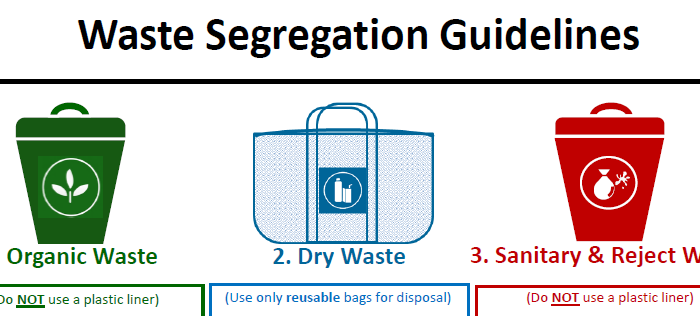
Tips and tricks – waste segregation

Here are some guidelines for successful waste segregation. These will ensure that most of the waste we generate gets composted or recycled, and does NOT end up in a landfill.
Dry waste (recyclable waste)

    • Pickup of dry waste happens thrice weekly – Monday, Thursday and Saturday. Please leave dry waste out ONLY on the designated days.
    • Please do NOT put dry waste into the red or green bins as otherwise FCs have to dig in and separate this. Use a jute bag for disposal (if you don’t have one, please buy this. Till then, use ANY large plastic bag with ONLY dry waste.
    • Milk packets/dosa batter/curd packets are not to be disposed in the green bin. Please rinse, and once dry you can dispose in the bag for recycling. [Tip: cut and leave soiled plastics at the bottom of your kitchen sink. They will get rinsed when the dishes are washed]
    • All scraps of paper, plastic, empty cosmetic/medicine bottles, broken mops/brooms, anything made of plastic/paper/metal/glass should go in the dry waste bag.
    • Food containers made from Aluminium foil or plastic can be easily recycled! Please rinse (along with your other dishes) and dispose in your dry waste bag.
    • Do rinse tetrapacks also (milk/juice/tomato puree etc) and dispose in the dry waste bag.
Wet waste (biodegradable kitchen waste)

    • Kitchen waste should be disposed off in a GREEN bucket without any plastic lining. If you do not have a green bucket, please purchase one or for now use what you have, but please ensure there is NO plastic in this whatsoever.
    • If you are throwing leftover food, please drain excess liquid in the sink before disposing, or if very watery, flush down the toilet. [Tip: leave leftover food in the fridge and throw in the morning just before waste collection, to avoid smell]
    • All veg and non-veg waste too is biodegradable and MUST be thrown in the green bin. Egg shells and tea bags can be thrown as well.
    • You can line your bin with paper but please use a single sheet and not the whole newspaper! You can check out the attached paper bags which are available through Town Essentials.
Rejects waste (sanitary waste)

    • Sanitary waste should be wrapped in newspaper, marked with an X, and disposed off in the RED bin. Please do this so that waste workers may be able to identify it easily and not have to handle it directly.
    • If you do not have a red bin, please use any other bin you may have, as long as it is kept separate from kitchen waste
    • Also a reminder to NEVER flush your sanitary waste as it clogs the sewage pipes.
    • Sanitary waste and all contents of RED bin go to the landfill, so please try to minimize this as much as possible. All plastics can and should be recycled – please rinse soiled plastic and use the bag to dispose, NOT the red bin.
Finally, here are some alternatives for your consideration which are safer for you and your family, and better for the planet that we leave behind for the next generation:
1. Bumberry makes reusable cloth diapers free from harmful chemical additives normally used to bleach regular diapers.
2. Ecofemme makes washable sanitary pads that are safer for your body. The organization has a social welfare aspect as well.
3. Shecup and Divacup are menstrual cups that are used by many women as alternatives to disposable pads and tampons.

Here’s to adopting more sustainable lifestyles and practices!
Cheers,

Dwarka Forum
Source: Internet

SDMC and Dwarka Forum joined hands to fight against Dengue, Chikungunya & Garbage disposal


Seeing the worsening situation & outbreak of Vector Borne diseases like Dengue and Chikungunya in Dwarka; Dwarka Forum took a lead and joined hands with SDMC.  Members of forum met DC Sh Sanjeev kumar today at Sec-23 Community Hall, Dwarka and demanded focus on fogging in schools, DDA Pockets and Group Housing societies on priority, segregation to reduce load on landfills, requested for efficient garbage pick-up and emphasized on decentralised composting.


Dwarka Forum members apprised Sh. Sanjeev Kumar regarding all the points and their present status of all the action points which were discussed during previous meetings. 

Dwarka Forum demanded a road map of garbage pick-up trucks so that it can be optimized for maximum output. At the same time, forum asked DC to help with providing dustbins-carts for the societies near dhalao to reduce burden on trucks.

Both Dwarka Forum  and DC agreed that all the dhalaos should work as composting sites and SDMC should only pick segregated garbage from the society as per MCD’s new notification on garbage segregation. However, Dwarka Forum pressed that SDMC should provide support to Dwarka Forum in educating the residents to initiate segregation and composting at source.

Dwarka Forum maintained that daily cleaning and picking up of garbage was not up to the mark and safayee karamcharis were often found absconded from their duty. DC took contingence of the same and promised to work with Dwarka Forum on ground every Saturday by visiting various sectors.

Dwarka Forum has been conducting awareness campaign on segregation and composting techniques in various societies.

On the request of a member, DC also assured installation of limited open Gyms in MCD parks. He asked Dwarka Forum to identify parks.

Workshop on waste segregation and composting at Anusandhan Apartments, Sector 6,Dwarka


Residents of Anusandhan Apartments, a residential society in Sector 6, Dwarka, are set to adopt composting and waste segregation methods following a workshop organised by Dwarka Forum on waste management on Tuesday.

Residents of the society, members of the managing committee and members of Dwarka Forum, including Madhuri Varshney, the president of the forum, discussed the subject at the community hall of the society.


Swarna Lata, an expert from Dwarka Forum on the subject, delivered a lecture and tried to raise awareness about the waste segregation and its benefits. She also responded to queries from residents and appealed to the members of the managing committee to adopt composting as soon as possible.

Lakhvinder Singh, secretary of the society, said, “We are happy that such an important awareness workshop was held by the Dwarka Forum team and Madhvi Kane, one of our residents, who took the initiative for the workshop. Now, we are going to have a pit for composting and give separate dustbins to the residents to segregate garbage.”


Madhuri Varshney, president of Dwarka Forum, said, “We are trying our best to promote the composting and waste management in the society. The support from various societies has been very encouraging. The response at Anusandhan Apartment was great today.


Source :CitySpidey

Jhelum Apartments Sec 5 ,Dwarka- Workshop on SWM and Composting


The PM wants Swacch Bharat, a clean India. You and We want clean India but for achieving this we indians have to change our perception, behaviour and sensitivity towards waste. Dwarka sub city is a well planned city but with poor sanitation and garbage disposal scheme. We can see garbage littered at every nook and corner. We all know garbage is money producer for SDMC because we citizen pay SDMC (in the form of various tax) for its scientfic disposal.


But what a citizen do when the agency not ready to render its services whole heartedly. Only one solution STOP GIVING THEM GARBAGE. Yes, that can be achieved by segregation at source and by adopting various method of composting at individual level or at society level.


Dwarka Forum spreading this awarness for the last 8 months and our vision was to constantly re-imagine our relationship with the mother earth, with each other and with our urban spaces. We are in the process of changing mindset about “waste”, about marginal livelihoods, about whose job it is to take care of “waste” etc. Since we are the garbage generator it is our responsibility primarily to do something for it.  In this row, Dwarka Forum organise various workshop in different societies of dwarka. This Sunday we had workshop at Jhelam Apartment, Sec-5, Plot-8, Dwarka. Residents was very willing to learn about segregation and what are the methods of composting. Managment team of Jhelam was very supportive and assured very soon they will start composting on their own.

Venue : Jhelum Apartments, Sector 5, Dwarka
Date: 11 Sep 2016

Dwarka Forum's Eco Warrior's :
  • Ms Swarna Latha
  • Ms Sudha Raj
  • Ms Geeta Dutt
  • Ms Madhuri Varshney
  • Ms Aprajita Gautam
Special Thanks to Mr. Anita Bhamrah , Other MC members and all Residents of Jhelum Apartments.

Government notifies new solid waste management rules (SWM Rule 2016)

The Union Ministry of Environment, Forests and Climate Change (MoEF&CC) recently notified the new Solid Waste Management Rules (SWM), 2016. These will replace the Municipal Solid Wastes (Management and Handling) Rules, 2000, which have been in place for the past 16 years.
These rules are the sixth category of waste management rules brought out by the ministry, as it has earlier notified plastic, e-waste, biomedical, hazardous and construction and demolition waste management rules.


The new rules are now applicable beyond municipal areas and have included urban agglomerations, census towns, notified industrial townships, areas under the control of Indian Railways, airports, special economic zones, places of pilgrimage, religious and historical importance, and State and Central Government organisations in their ambit.

Major highlights of the new SWM Rules, 2016
Segregation at source
The new rules have mandated the source segregation of waste in order to channelise the waste to wealth by recovery, reuse and recycle. Waste generators would now have to now segregate waste into three streams- Biodegradables, Dry (Plastic, Paper, metal, Wood, etc.) and Domestic Hazardous waste (diapers, napkins, mosquito repellants, cleaning agents etc.) before handing it over to the collector.
Institutional generators, market associations, event organisers and hotels and restaurants have been directly made responsible for segregation and sorting the waste and manage in partnership with local bodies. In case of an event, or gathering of more than 100 persons at any licensed/ unlicensed place, the organiser will have to ensure segregation of waste at source and handing over of segregated waste to waste collector or agency, as specified by the local authority.
All hotels and restaurants will also be required to segregate biodegradable waste and set up a system of collection to ensure that such food waste is utilised for composting / biomethanation. The rules mandate that all resident welfare and market associations and gated communities with an area of above 5,000 sq m will have to segregate waste at source into material like plastic, tin, glass, paper and others and hand over recyclable material either to authorised waste-pickers and recyclers or to the urban local body.

Collection and disposal of sanitary waste
The manufacturers or brand owners of sanitary napkins are responsible for awareness for proper disposal of such waste by the generator and shall provide a pouch or wrapper for disposal of each napkin or diapers along with the packet of their sanitary products.
Collect Back scheme for packaging waste
As per the rules, brand owners who sale or market their products in packaging material which are non‐biodegradable, should put in place a system to collect back the packaging waste generated due to their production.

User fees for collection
The new rules have given power to the local bodies across India to decide the user fees. Municipal authorities will levy user fees for collection, disposal and processing from bulk generators. As per the rules, the generator will have to pay User Fee” to the waste collector and a “Spot Fine” for littering and non-segregation, the quantum of which will be decided by the local bodies.   
Also, the new rules have mentioned about the integration of rag pickers, waste pickers and kabadiwalas from the informal sector to the formal sector by the state government.
The rules also stipulate zero tolerance for throwing; burning, or burying the solid waste generated on streets, open public spaces outside the generator’s premises, or in the drain, or water bodies.

Waste processing and treatment
As per the new rules, it has been advised that the bio-degradable waste should be processed, treated and disposed of through composting or bio-methanation within the premises as far as possible and the residual waste shall be given to the waste collectors or agency as directed by the local authority. The developers of Special Economic Zone, industrial estate, industrial park to earmark at least 5 per cent of the total area of the plot or minimum 5 plots/ sheds for recovery and recycling facility.
Waste processing facilities will have to be set up by all local bodies having a population of 1 million or more within two years. For census towns with a population below 1 million or for all local bodies having a population of 0.5 million or more, common, or stand-alone sanitary landfills will have to be set up in three years time. Also, common, or regional sanitary landfills to be set up by all local bodies and census towns with a population under 0.5 million will have to be completed in three years.
Also, the rules have mandated bio‐remediation or capping of old and abandoned dump sites within five years.

Promoting use of compost
As per the rules, the Department of Fertilisers, Ministry of Chemicals and Fertilizers should provide market development assistance on city compost and ensure promotion of co‐marketing of compost with chemical fertilisers in the ratio of 3-4 bags is to 6-7 bags by the fertiliser companies to the extent compost is made available for marketing to the companies. Also, the Ministry of Agriculture should provide flexibility in Fertiliser Control Order for manufacturing and sale of compost, propagating use of compost on farm land, set up laboratories to test quality of compost produced by local authorities or their authorised agencies.

Promotion of waste to energy
In a not-so welcoming move, the SWM Rules, 2016 emphasise promotion of waste to energy plants. The rules mandate all industrial units using fuel and located within 100 km from a solid waste-based Refuse-Derived Fuel (RDF) plant to make arrangements within six months from the date of notification of these rules to replace at least 5 per cent of their fuel requirement by RDF so produced.
The rules also direct that non-recyclable waste having calorific value of 1500 K/cal/kg or more shall be utilised for generating energy either through RDF not disposed of on landfills and can only be utilised for generating energy either or through refuse derived fuel or by giving away as feed stock for preparing refuse derived fuel. High calorific wastes shall be used for co-processing in cement or thermal power plants.
As per the rules, the Ministry of New and Renewable Energy Sources should facilitate infrastructure creation for Waste to Energy plants and provide appropriate subsidy or incentives for such Waste to Energy plants. The Ministry of Power should fix tariff or charges for the power generated from the Waste to Energy plants based on solid waste and ensure compulsory purchase of power generated from such Waste to Energy plants by discoms.
Revision of parameters and existing standards
As per the new rules, the landfill site shall be 100 metres away from a river, 200 metres from a pond, 500, 200 metres away from highways, habitations, public parks and water supply wells and 20 km away from airports/airbase. Emission standards are completely amended and include parameters for dioxins, furans, reduced limits for particulate matters from 150 to 100 and now 50. Also, the compost standards have been amended to align with Fertiliser Control Order.
Management of waste in hilly areas
As per the new rules, construction of landfills on hills shall be avoided. Land for construction of sanitary landfills in hilly areas will be identified in the plain areas, within 25 kilometers. However, transfer stations and processing facilities shall be operational in the hilly areas.
Constitution of a Central Monitoring Committee
The government has also constituted a Central Monitoring Committee under the chairmanship of Secretary, MoEF&CC to monitor the overall implementation of the rules.   The Committee comprising of various stakeholders from the Central and state governments will meet once a year to monitor the implementation of these rules.
Way ahead
It will take almost 4-5 years to see the drastic change in how the waste management regimes will work in India. The SWM Rules, 2016 diminish hopes in pushing for adoption of a decentralised mechanism for solid waste management. However, it would be challenging to see how segregation at source shall work on the ground. A massive awareness campaign in association with communities, NGOs, students and other stakeholders needs to be planned to push for better implementation of these rules. The Rules need to focus on making solid waste management a people's movement by taking the issues, concerns and management of solid waste to citizens and grass-roots.


Dwarka Forum Discussion Group

Latest Posts

Recent Posts Widget